
FEATURED EVENT
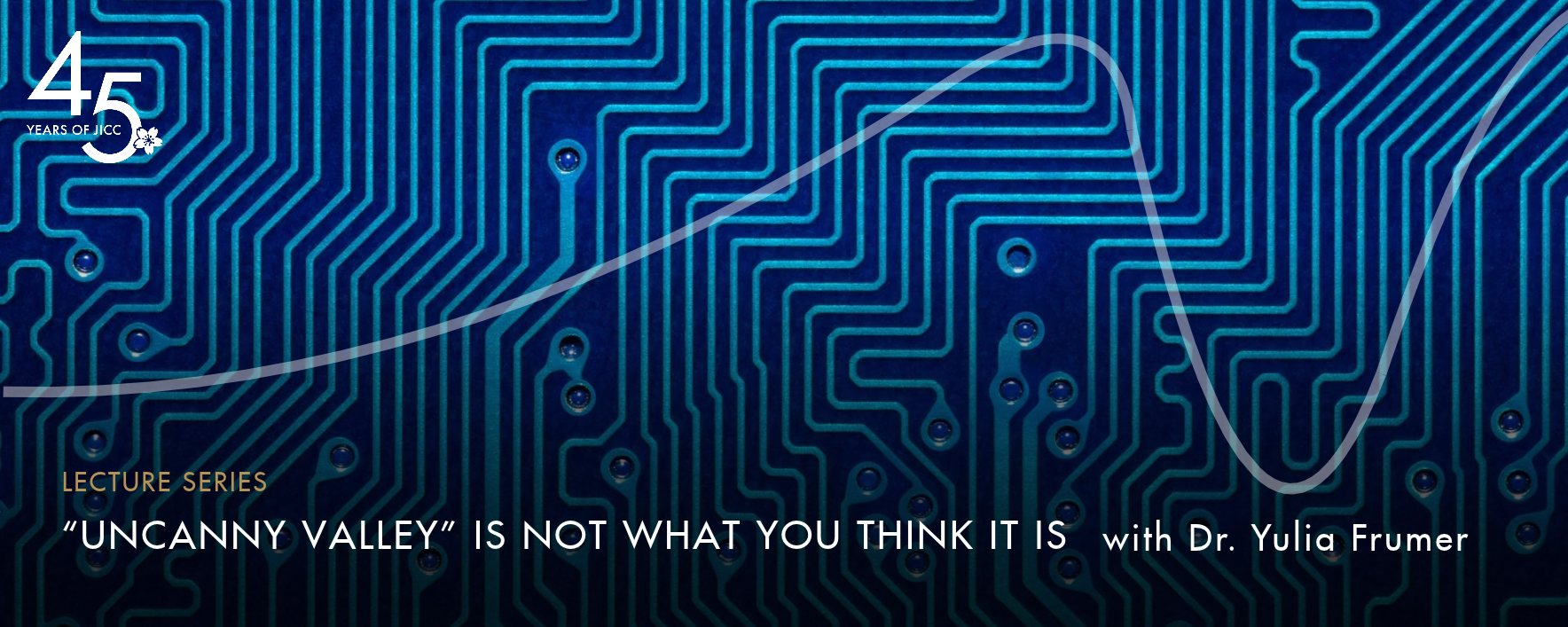

LECTURE | 不気味の谷 “UNCANNY VALLEY” IS NOT WHAT YOU THINK IT IS
Today, people often use the phrase “uncanny valley” (不気味の谷; bukimi no tani)
to describe the uneasy feeling caused by robots that look almost, but not quite, human. However,
this common view misses an important part of what Japanese engineer Mori Masahiro meant when he first
introduced the idea in the late 1960s.
Newly discovered sources, along with a closer look at Mori's language and the context in which he wrote,
offer a greater understanding of his argument. For Mori, the key issue was not simply how closely a
product resembled a human, but how engineers could design products that people would respond to positively.
Rather than warning engineers away from human-like designs altogether, Mori encouraged them to examine
alternative ways to shape users' perceptions and responses, not just through mimesis.

Table for Two | Onigiri Action
Following the talk, celebrate the fall season with Onigiri Action, TABLE FOR TWO’s annual social good campaign. Every photo of a onigiri (おにぎり; rice ball) posted on the campaign website or your social media with #OnigiriAction provides five school meals to children in need. Participants will have the opportunity to make and enjoy onigiri while learning how this simple, beloved food continues to bring people together and make a global impact.


ABOUT THE PRESENTER

Dr. Yulia Frumer
Professor of East Asian Science and Technology,
Johns Hopkins University
Dr. Yulia Frumer
is an associate professor of East Asian Science and Technology at the History of Science and
Technology Department, Johns Hopkins University. Frumer is a historian of science and
technology in East Asia, specializing in Japan. Her work addresses a variety of topics
such as robotics, prosthetics, technology and labor, technology and emotions, time,
astronomy, measurement instruments, science fiction, and scientific translation.
Frumer earned her Ph.D. at Princeton University and has held visiting positions at the
Institute for Advanced Study at Princeton, Tokyo University, and the Max Planck Institute
for the History of Science. Numerous prestigious fellowships have supported her work,
including the NSF, the Japanese Society for the Promotion of Science, and the Japan Foundation.
Her first book (Making Time, Chicago 2018) explored the evolution of astronomical time
measurement and the conceptions of time in Tokugawa Japan. In a co-authored book on animation
practices (Animating Action, Hawaii 2026), she explores robotic technologies intended
to emulate empathy and agency. Her single-authored manuscript on the history of Japanese
robotics will be published with University of Pittsburgh Press in 2027.
PHOTO & VIDEO POLICY: The Japan Information & Culture Center (JICC), Embassy of Japan reserves the right to use any photograph/video taken at any event sponsored by JICC, without the expressed written permission of those included within the photograph/video. JICC may use the photograph/video in publications or other media material produced, used or contracted by JICC including but not limited to: brochures, invitations, newspapers, magazines, television, social media, websites, etc. To ensure the privacy of individuals and children, images will not be identified using full names or personal identifying information without written approval from the photographed subject, parent or legal guardian. A person attending a JICC event who does not wish to have their image recorded for distribution should make their wishes known to the photographer/videographer, and/or the event organizers.